.png)

A Romp through the Stars
Bala Sivakumar

Since a kid, I’ve always been fascinated by the skies. Seeing shapes in the clouds, learning about constellations – the skies were always endlessly mesmerizing. From when I could talk, I’ve always wanted to be a ‘Cosmonaut’ (blame it growing up on Russian books from the Indian-Soviet cultural exchange), devouring as much astronomy knowledge as I could lay my hands on.
Since a kid, I’ve always been fascinated by the skies. Seeing shapes in the clouds, learning about constellations – the skies were always endlessly mesmerizing. From when I could talk, I’ve always wanted to be a ‘Cosmonaut’ (blame it growing up on Russian books from the Indian-Soviet cultural exchange), devouring as much astronomy knowledge as I could lay my hands on.
Fast forward to the present – photography is a passion and an active hobby, but astronomy has taken a backseat. As a landscape photography enthusiast, I love to travel and hike into the wilderness – far from urban centers. I’ve known there are telescopes with SLR mounts, but I was reluctant to add another piece of equipment to haul on my hikes.
 |
| Click image to see in Hi-res. |
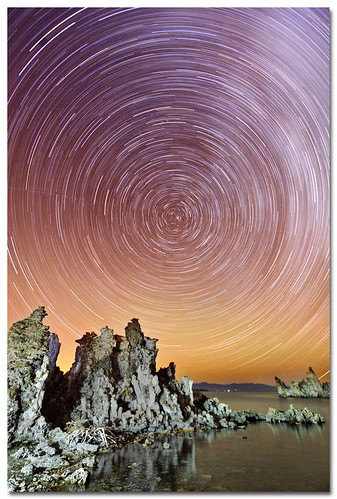
‘Star Trails’ – are just long exposures; very longactually! Seeing the actual motion of the stars captured in a photo is a powerful reminder that the universe is continually moving! The stars in the sky move around the North-Pole-star, revolving around it in a circular fashion.
 |
| Click image to see in Hi-res. |
Star trails lend to interesting composition choices – shots including the pole star or not. I tend to include the pole star in my compositions because I like the vortex effect – shown in this photo. I took this at Mono Lake where the tufas make for an interesting foreground. A small flashlight helped illuminate the tufas during this 80 minute exposure. A rising moon also helped illuminate the scene – although a full moon would have made the skies too dark for the trails to be clearly visible.
It was on the same trip that I also visited the Ancient Bristlecone Pine forest. I cannot fully convey how excited I was to visit this place! It is home to the oldest known living creatures – the ancient bristlecone pine trees. It was a long and winding drive to get to here, but worth it. The high altitude (12000 ft) makes for low light pollution – important for any kind of night sky photography!
I light painted the foreground (the pine trees) with my flashlight during my exposure that lasted for over an hour. Very little light was required from my flashlight – I would shine the light for just a couple of seconds every 10 to 15 minutes. The long exposure, combined with dark skies made for a lot of star trails – all revolving around the pole star (Polaris).
 |
| Click image to see in Hi-res. |
But there are other kinds of astrophotography shots besides just star trails. Remote places far away from sources of light pollution like big cities are great locations to see and photograph the night sky. Sometimes the sky is so dark that you can see the Milky Way very clearly.
Traditionally, the only way to photograph the details of the night sky (without streaks or trails) has been to use a tracking mount with a telescope. Recent leaps in camera technology has made this feasible without such specialized equipment. For this shot of the ancient bristlecone pine tree with the Milky Way in the background – I just cranked up the ISO sensitivity of my camera to 3200. The tree was lit with my LED headlamp as I stood gazing at the skies.
 |
| Click image to see in Hi-res. |
Another important factor is the exposure time. Unlike star trails, a long exposure does not work well here. Depending on the focal length of the lens used, the motion of the stars will become apparent in a long exposure. I make sure I have a fast lens (capable of at-least f2.8) for such shots, so I can use shutter speeds up to 30mm without streaking of the stars.
 |
| Click image to see in Hi-res. |
I shot all the photos on this page on a clear, new-moon night. This ensured the night sky would be dark with maximum visibility of the Milky Way. The most important factor to get good shots of the night sky is to ensure minimal light pollution. http://www.jshine.net/astronomy/dark_sky/ is an excellent resource to help finding places with high visibility of dark skies. For dwellers of the Seattle area, eastern Washington has some of the darkest skies around.
 |
| Click image to see in Hi-res. |
I hope you have enjoyed this photo-romp through the stars with me as much as I have. Don’t forget to share results of your adventures with the night sky with me at bala@wanderingmonkphoto.com


