Showing posts with label Drama. Show all posts

I AND YOU - A Popular Story With Unconventional Story Tellers

Lauren Gunderson is one of the most produced playwrights in the country right now, and I and You is one of her more frequently produced plays. Including Pratidhwani and Theater Schmeater's co-production that starts performances Oct 18th, there have been three productions or readings of it in Seattle in 2018 alone, and a fourth is already scheduled for early 2019.
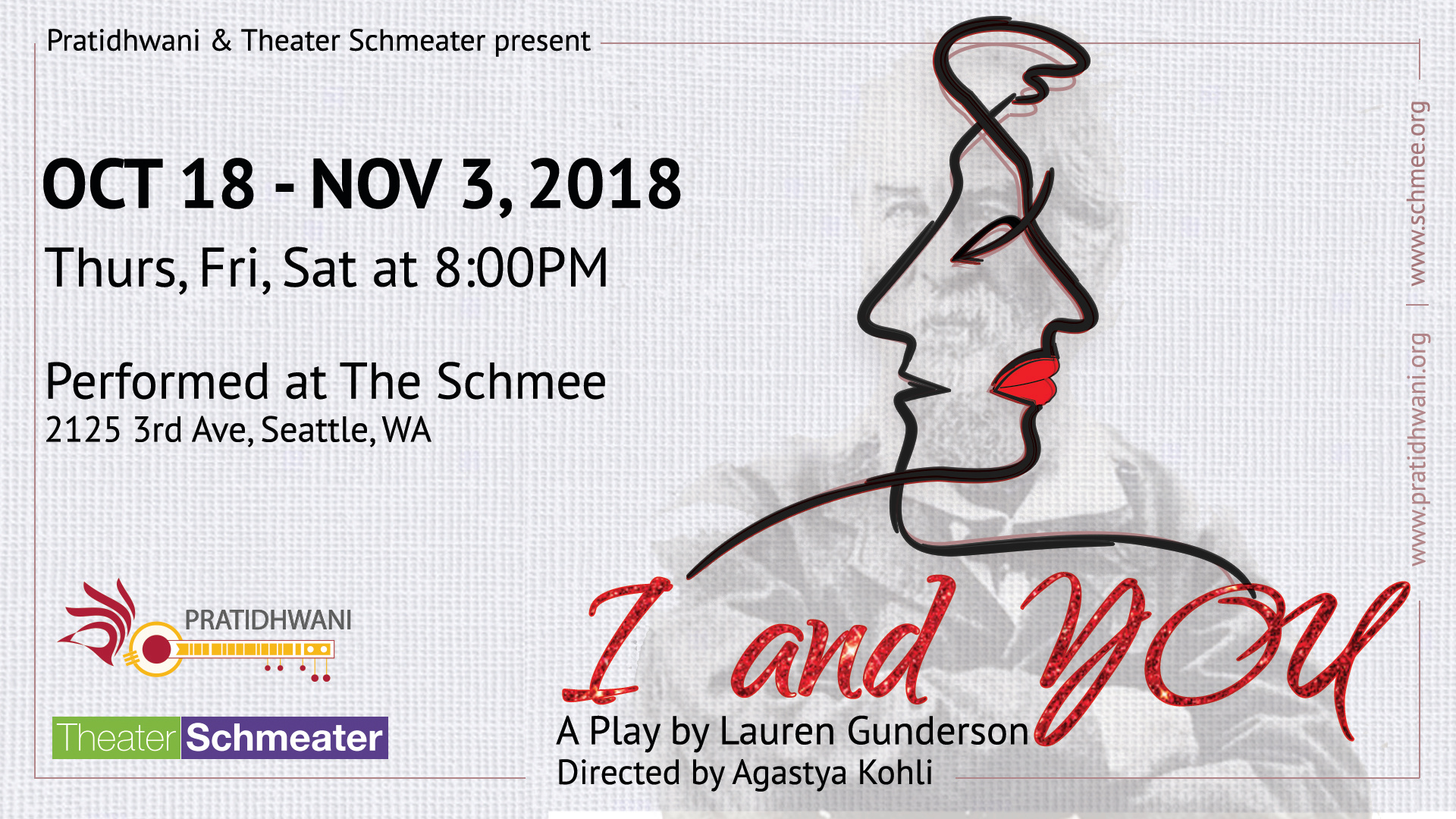

This play was originally written to be performed by a white actress and a black actor. The playwright’s guidance, however, allows for performers of other ethnicities to be cast in it, as long as the two actors are not of the same race. With Pratidhwani’s mission to create more opportunities for artists of South Asian descent in mind, we naturally, approached this play from a different lens right from the beginning, and arrived at our casting of an Indian American Caroline, and a Japanese American Anthony.


What has made the process more exciting for us, is to explore how that casting choice changes Caroline, or Anthony, or their respective parents and their family dynamics. How some of the lines in the play might take on a slightly different meaning, and how breaking the standard of “default expectations” makes this production just a little different, while very much being a part of the collective, part of the current zeitgeist - continuing the conversation the playwright has started. We hope you will join us, witness the production yourself, and share your experience with us. www.pratidhwani.org/iandyou


Take A Chance

By Archana Srikanta

One of my acting teachers once told me that an actor’s job is to be in endless pursuit of perfection. There is no objective end to the work you can put into a character. He taught us that we must never become complacent and satisfied with our performance. He said to always bring in something new to try out at every rehearsal. Come in with a willingness to experiment, a willingness to say that line differently or do an action differently so that you may discover a new and better way. And let me tell you (as I’m sure every actor will attest) trying to change how you say a line after having consistently said it in a certain way for the past 50 times is hard!


And it’s a brave thing to do. To embrace change. To experiment with something new, when you don’t know if it will even work. You’ll probably fail 10 times for every one time that you do succeed. But you do it again and again, because it’s the only way to the next truth.
Actors are brave because they take a chance on acting choices, academic researchers are brave because they take a chance on new ideas, bees are brave because they take a chance on a new Queen to sustain the colony. Perhaps there is a life lesson here (like so many other things I learnt from my foray into acting). Success is rarely about being innately gifted or talented. It’s about being habitually brave enough to fail and start over. There is no shortcut. The audience will applaud your eventual success, but it’s the perseverance through past failures that probably deserves the louder applause.


For tickets and more information, visit 
https://www.pratidhwani.org/queen 

 Queen

Conflict, Compromise, and Bees

By Agastya Kohli

“It is not given to man to know the whole Truth”, Mahatma Gandhi is quoted to have said. “His duty lies in living up to the truth as he sees it. God alone knows absolute Truth. Therefore I have often said, Truth is God.” He then goes on to say, “Relative truth is all we know. Therefore we can only follow the truth as we see it.”

Agastya Kohli
Artistic Director, Drama Wing
We are witnessing a time when it seems, the two halves of this country firmly believe in only their relative truth - as they see it. Amazingly, when confronted with the same exact facts, the two sides draw up completely opposite conclusions, which are equally obvious to each of them. 

Truth it appears, can contradict itself. Or how we perceive it, can certainly be contradictory.

Queen by Madhuri Shekar is a brilliant study of the nature of truth. In it, one relative truth, as Ariel knows it, is that Monsanto’s pesticides are destroying honeybee populations. The other truth, as Arvind tells it, is that Monsanto are innovators and job creators. While this knowledge will absolutely color the way they (and we) perceive Monsanto, they are both “living up to the truth” as they see it, unknowingly following Gandhi’s example!

Mathematics is Sanam’s truth. Without mathematical evidence, all claims are anecdotal. But Prof. Hayes tells us “mathematics isn’t a direct path to god, to the universe.” It too can lead to different results when the same data is examined from different perspectives.

Understanding the nature of truth isn’t necessarily about looking at the picture from the other side, walking in someone else’s shoes. While that might help us understand the other person’s relative truth, it certainly doesn’t negate what we hold as self evident. What is perhaps needed then, is compromise.

But is compromising one’s truth a betrayal of God’s trust? Or is it the only way to get things done?

To quote Gandhi again, “in matters of conscience, the law of the majority has no place. Even if you are a minority of one, the truth is the truth. When you know the truth, the truth makes you a soldier.” 

Gandhi changed the world. His commitment to his relative truth was near absolute.  However, absolute commitment to a relative truth can not lead to compromise - only to conflict. Conflict in which friendships, careers, reputations - all can get destroyed, that compromise might salvage.

Conflict makes for good drama. Each character committed to their own truth, to their own God. Hope you’ll make time to come and see Queen - a play about truth, about compromise, and about bees.

For tickets and more information, visit 
https://www.pratidhwani.org/queen 

 Queen